I have to admit something. When I first read that deliberately changing the way you breathe could lower your blood pressure, improve your sleep, reduce anxiety and boost your energy levels, I was sceptical. It sounded like the kind of vague wellness advice that fills the gap between actual science and something useful.
But breathing exercises after 60 turned out to be one of the most evidence-backed, zero-cost tools I’ve added to my routine – and I wish I’d found them years earlier. Let me explain what I discovered and what actually works.
🫁 Wait – Don’t We Already Know How to Breathe?
That’s exactly what I thought. Breathing is automatic. We’ve been doing it roughly 20,000 times a day since birth. What is there to learn?
Quite a lot, it turns out. Most of us – especially those who’ve spent decades at a desk, dealing with stress, or simply never thought about it – have developed poor breathing habits. Shallow, rapid chest breathing that keeps the body in a low-level stress state. The diaphragm – the large dome-shaped muscle designed to do most of the work – barely gets used.
After 60, this matters more than ever. Lung capacity naturally declines with age. The muscles involved in breathing can weaken. And the nervous system becomes more prone to staying in “alert” mode, which shallow breathing actively worsens. Learning to breathe properly is not a minor thing – it’s correcting a fundamental physiological habit that affects nearly every system in your body.
🔬 What the Science Says
The research here is genuinely impressive, and it’s moved well beyond the realm of alternative wellness into mainstream cardiology and respiratory medicine.
Blood pressure. Slow, controlled breathing – particularly at around 5 to 6 breaths per minute – has been shown in multiple clinical studies to significantly reduce both systolic and diastolic blood pressure. The effect is comparable in some studies to a low-dose medication, without the side effects. For those of us monitoring our cardiovascular health, this is not a small thing.
The nervous system switch. Every slow, deep exhale activates the parasympathetic nervous system – the “rest and digest” state that counteracts the chronic stress response. This is the mechanism behind the vagal nerve stimulation I wrote about previously, and breathing is one of the most direct ways to access it. Deliberately slowing your exhale tells your nervous system, at a physiological level, that you are safe.
Lung capacity and respiratory muscle strength. Specific breathing exercises – particularly those that involve resistance on the exhale – have been shown to slow the age-related decline in lung function and actually strengthen respiratory muscles. For older adults, better lung function correlates with better overall physical endurance, faster recovery from illness, and even cognitive performance.
Anxiety and mood. A growing body of research shows that controlled breathing reduces cortisol levels and activates the brain’s prefrontal cortex – the rational, calm part – while quieting the amygdala, which drives the anxiety response. The effect is rapid. Some techniques produce measurable changes in anxiety levels within a few minutes. Used alongside other stress-management habits, the effect compounds.
🧘 The Techniques I Actually Use
I’ve tried a lot of these over the past several months. Here are the ones that stuck – and why.
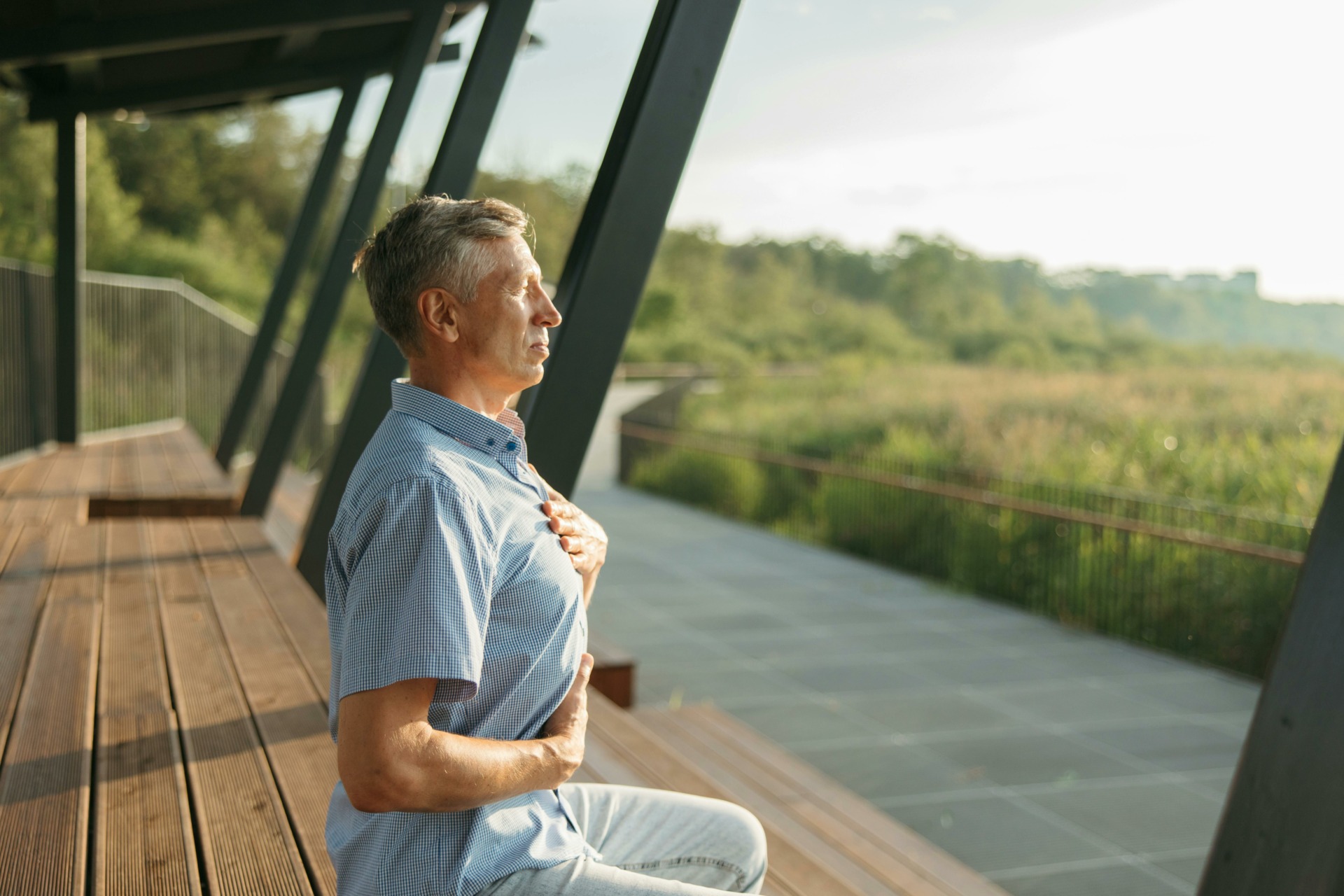
Diaphragmatic breathing – the foundation. Before anything else, learn to breathe into your belly rather than your chest. Lie on your back, place one hand on your chest and one on your stomach. Breathe in slowly through the nose – only the hand on your stomach should rise. The chest hand stays still. This is how we’re designed to breathe, and most of us have forgotten how. I practise this for five minutes every morning, and it took about two weeks before it started to feel natural.
Box breathing – for stress and focus. Breathe in for 4 counts, hold for 4, breathe out for 4, hold for 4. Repeat for 4 to 5 cycles. This technique is used by surgeons, athletes and military personnel to manage high-pressure situations. I use it before anything I know will be stressful – a difficult phone call, a medical appointment, a disrupted night of sleep. It works quickly and reliably.
4-7-8 breathing – for sleep. Breathe in for 4 counts, hold for 7, breathe out slowly for 8. The extended exhale is the key – it strongly activates the parasympathetic response and drops heart rate noticeably. I do 4 cycles of this in bed when I can’t switch off. It doesn’t always work instantly, but it works consistently over a few nights. It pairs well with the other habits in my guide to sleep after 60.
Resonance breathing – for blood pressure. Also called coherent breathing – simply breathe in for 5 seconds and out for 5 seconds, continuously, for 10 to 20 minutes. This brings your breathing rate to around 6 breaths per minute, which is where the strongest cardiovascular benefits appear in the research. I do this once a day, usually in the afternoon, either sitting quietly or on a slow walk. It feels almost meditative after a few sessions.
Pursed lip breathing – for lung health. Breathe in slowly through the nose for 2 counts, then exhale through pursed lips (as if blowing out a candle) for 4 counts. This creates mild resistance on the exhale, which keeps the airways open longer and strengthens the breathing muscles. Physiotherapists use this with patients recovering from chest conditions. It’s simple and worth doing daily if your lung health is a concern.
📅 How I’ve Built It Into My Day
The beauty of breathwork is that it requires no equipment, no gym membership, no special time slot. Here’s how I’ve woven it in without it feeling like another chore:
- Morning – 5 minutes of diaphragmatic breathing while still in bed before I get up. Sets the tone for the day.
- Midday – 10 minutes of resonance breathing, often while sitting in the garden with a coffee.
- Pre-sleep – 4 cycles of 4-7-8 breathing once the lights are off.
- On demand – box breathing whenever stress arrives uninvited.
That’s less than 20 minutes a day in total, spread across natural pauses that already exist in my routine.
⚠️ A Few Practical Notes
Some breathing techniques – particularly those involving breath holding – can cause light-headedness at first, especially if you’re not used to them. Always practise sitting or lying down until you know how your body responds. If you have any respiratory conditions such as COPD or asthma, check with your GP before starting any structured breathwork practice.
Also – and this surprised me – some people find that focused breathwork initially increases anxiety rather than reduces it. If that happens, start with the simplest technique (diaphragmatic breathing only) and build very gradually. The goal is calm, not another source of pressure.
🏁 The Bottom Line
Breathing exercises after 60 are not a substitute for medication, exercise, or good nutrition. But as a free, always-available tool for managing blood pressure, stress, sleep and lung health – they deserve far more attention than they get.
I spent years looking for expensive solutions to problems that, it turns out, I could partly address by simply breathing differently. The science is solid, the techniques are simple, and the only investment required is a few minutes of your attention each day.
Give box breathing a try today – just 4 cycles takes under two minutes. Then let me know in the comments whether you felt a difference. I’d genuinely love to hear your experience. 👇
Photo by Anastasia Shuraeva: https://www.pexels.com/photo/man-sitting-on-wooden-platform-on-the-park-8795385/